

Artemis II: Return to the Moon, also thanks to Swiss technology
The Artemis II mission will launch on 6 February 2026 at the earliest. The goal is to send a crew of four astronauts on a flight around the Moon. Switzerland has also contributed to this mission through ESA, which will see humans fly to Earth's natural satellite for the first time in half a century.
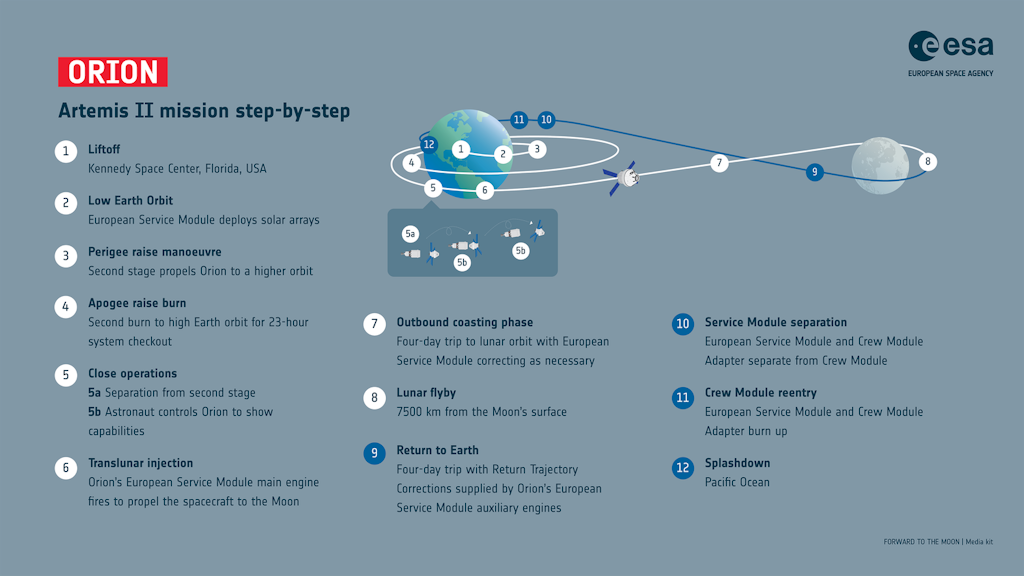
Four astronauts from the US and Canadian space agencies (NASA and CSA) will be on board. They will fly around the moon once and then return to Earth. The mission will last ten days. It forms part of the Artemis programme, which aims to land humans on the moon again (see information box).
The Artemis II mission will provide new insights into the Moon, its surface structures and its radiation environment. Studies on the health of the crew will also help scientists better understand on how deep space travel influences the human body.
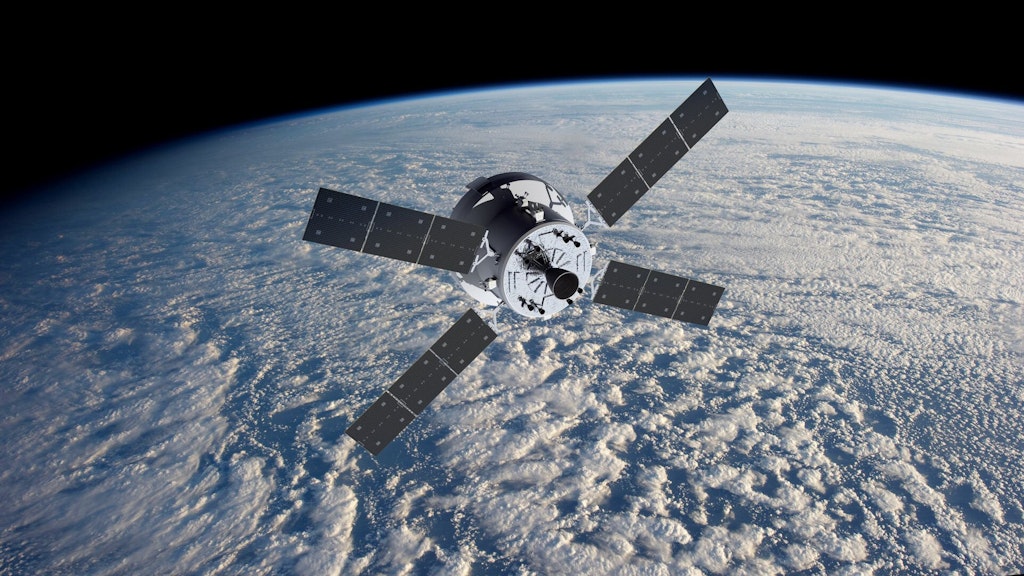
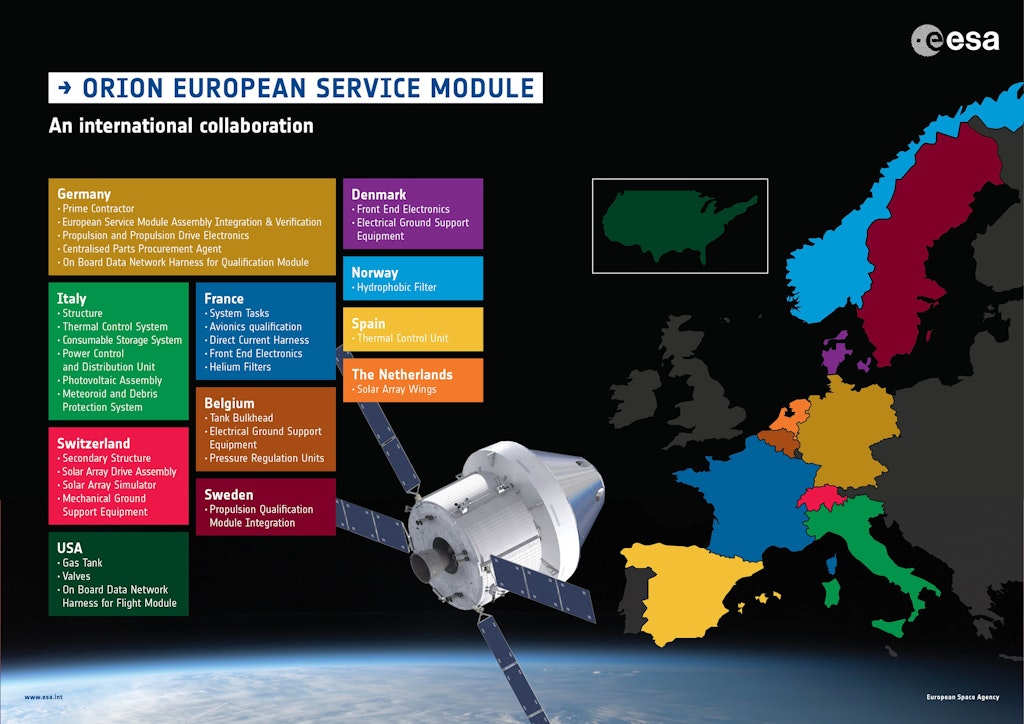
The astronauts will fly in the Orion capsule, which is propelled by the European Service Module (ESM). Via its solar panels, it also supplies the capsule with electricity. In addition, it regulates the climate and temperature in the capsule and stores oxygen and water supplies for the crew. It was developed and built by the European Space Agency (ESA) via contracts that were awarded to companies in ESA Member States. Swiss companies made crucial contributions to the ESM: the secondary structure, which is designed around the cylinder as the core element of ESM, the drive motors for the four solar panels, and the ground support equipment for assembling the ESM.
The timing of the flight depends on weather conditions, amongst other factors. Alternative launch windows are planned for February, March and April 2026.
Artemis II is part of the Artemis programme, a collaboration between NASA, CSA, ESA and the Japanese space agency JAXA. The programme aims to gradually return humanity to the Moon and establish permanent stations there. The programme includes, inter alia, the construction of Lunar Gateway, a space station in lunar orbit, the Orion capsule, which will transport astronauts and equipment to Lunar Gateway and the Moon, as well as the launch vehicle called Space Launch System (SLS), which will carry Orion into space. During the Artemis I mission, the Orion capsule was tested without a crew in 2022. The Artemis III mission aims to land humans on the Moon. As part of the Artemis programme, ESA astronauts will also fly to the Lunar Gateway or the Moon.