
European Southern Observatory for astronomy research
The European Southern Observatory (ESO) was built for the purpose of constructing and operating advanced astronomical observatories in the southern hemisphere. At the same time, the aim is to encourage and organise European cooperation initiatives in the area of astronomy research. Switzerland is a member country of the ESO.
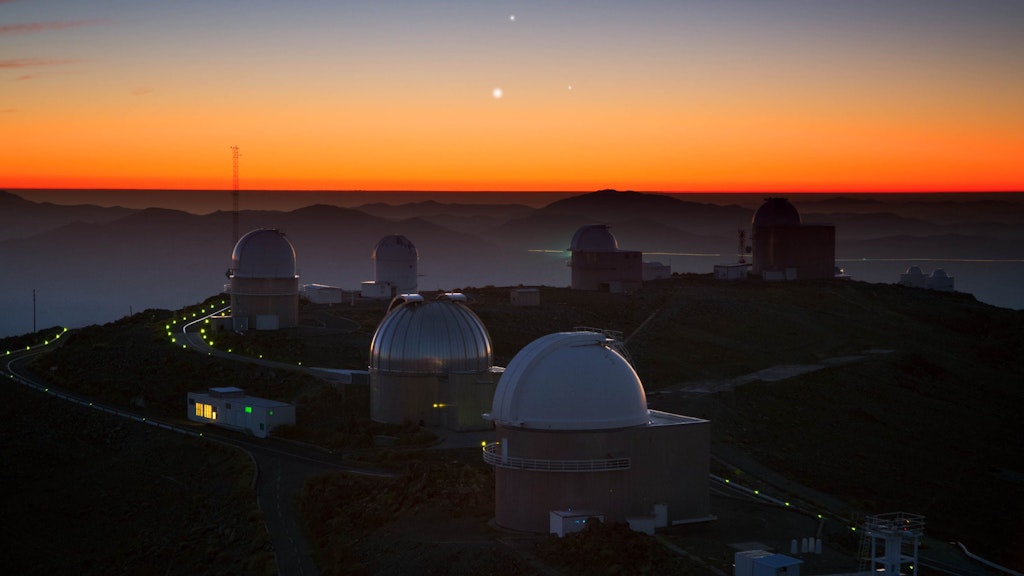
Founded in 1962, the ESO is one of the main institutions for European astronomy research. Headquartered in Garching bei München (Germany), the ESO brings together 16 member countries, including Switzerland. The ESO operates and builds observatories in the southern hemisphere, in Chile, to benefit from the exceptional observation conditions found in the Atacama Desert:
- La Silla Observatory: this site includes several medium-sized telescopes (including the one built and operated by the Geneva Observatory, measuring 1.2m in diameter).
- Very Large Telescope (VLT): this combination of four telescopes, located on the Cerro Paranal, is equipped with mirrors measuring 8.2 metres in diameter. In interferometric mode (VLTI), the VLT allows objects in space to be seen with a resolution 25 times greater than that of any of the individual main telescopes.
- Extremely Large Telescope (ELT): currently under construction on the Cerro Amazones, the ELT will become the world’s largest telescope for visible and near infrared light. With its 39-metre mirror, the ELT will be 100 times more sensitive than the VLT. The first observations are planned for 2028.
- Atacama Large Millimeter Array (ALMA): the ESO also participates in the international Atacama Large Millimetre Array (ALMA) project – a network of 64 radio telescopes, each with a diameter of 7–12 metres. This array is located on the Chajnantor Plateau at an altitude of 5,100 metres. This project is the result of collaboration between the ESO, Japan and the United States.
Swiss participation
As a member of the ESO since 1981, Switzerland has enjoyed privileged access to the ESO’s advanced astronomy infrastructures. Swiss researchers take part in large-scale projects. At the same time, Swiss universities in Bern, Geneva and Lausanne actively contribute technological and scientific input to discoveries in astrophysics. Research activities in Switzerland include the search for planets outside our solar system and the study of the evolution of galaxies.
Swiss businesses and institutions, particularly high-tech industries, are also involved in the construction of ESO infrastructures. Interested companies and institutions can obtain more information by contacting the Swiss ILO Office.
State Secretariat for Education, Research and Innovation SERI
Kevin Reymond