
Guidelines and applicable rules for submitting a proposal to the Swiss Space Office
Specific programmes of the European Space Agency ESA (e.g. ARTES, GSTP, NAVISP, etc.) require the explicit funding authorisation of the national ESA Delegation ("letter of support" or "letter of authorisation"). This section outlines the associated guidelines and applicable rules to obtain such a letter.
General principles
Switzerland's investment in the ARTES, GSTP and NAVISP technology programmes aims at developing strong technological niches, based on the principles of excellence, competitiveness and cooperation, and in alignment with the Swiss Space Policy.
Therefore, technology activities in these programmes, both under competitive tenders and co-funded schemes, should be approached by interested actors with a strong strategic orientation towards commercial technologies, products and services.
In a nutshell, successful funding requests are broadly characterized by the following qualities:
- Viable, strategic approach with respect to the topic and the domain of interest,
- Industry-led, built on strong R&D heritage,
- Strong case for future commercial ROI in Switzerland, and
- Clearly embedded in a tangible, and convincing commercial strategy
Funding requests
This section covers specific topics that are important if you plan to request funding from the Swiss Delegation to ESA under a programme that requires a letter of support or authorisation.
Evaluation process and timeline
The evaluation process is slightly different for fully-funded, open competition activities and ESA co-funded, industry initiated activities.
Process for ESA co-funded activities (Industry Initiated)
Proposals for ESA co-funded activities are evaluated three times a year. The current submission deadlines are as follows:
- 11 March 2026 end of business (CEST)
- 12 June 2026 end of business (CEST)
- 23 October 2026 end of business (CEST)
Process for fully funded activities (Open Competition)
Funding requests for fully funded activities issued as open competition tenders are evaluated on a rolling basis.
Owing to the strategic nature of the competitive funding instruments, we encourage interested parties to consult and work with the regularly updated activity workplans in ARTES, GSTP and NAVISP technology development programmes (see below unter "Fully funded activities") and to avoid submitting funding requests for already open ITTs in an opportunistic approach.
Online submission
Funding request must be submitted by e-mail to space-tech@sbfi.admin.ch in compliance with the formal requirements (described in the next section).
Reception will usually be confirmed within two business days. Incomplete applications will be rejected, but you can resubmit them by the next deadline. Evaluation will happen within 6-10 weeks of the deadline and/or submission, depending on the nature of the request (industry initiated with evaluation deadline or under competition).
Formal requirements
Funding requests for activities in Open Competition (fully-funded) may be submitted by entities (e.g., companies, research institutes) based in Switzerland. The requestor's strategy must be to bring sustainable added value to Switzerland, and the proposed activities must support implementation of this strategy. In addition, the proposed activities must be aligned with the Swiss Space Policy.
A complete funding request for any of the programmes mentioned above consists of the following elements
- Overview Form for Technology and Telecommunication proposals (see below under "Guidelines and forms" for the links)
- Project Description, or «Vademecum», with a detailed description of the activities
The «Guidelines for Requestors: Technology» describe in detail the requirements for the project description, its scope, and the answers it must provide.
Further elements and instructions
ARTES, GSTP and NAVISP programmes provide templates and guidelines for writing a good Outline Proposal, including questions on the Business Case and other elements.
- Documents for ARTES C&G, ScyLight & Entry
- Documents for ARTES Business Applications (BASS)
- Documents for GSTP Element 6 «Make» (6.2)
- Documents for NAVISP Element 2
The project description ("Vademecum") for funding requests under co-funded ESA programmes shall be based on these Outline Proposal templates.
A solid preparation of the funding request, including a good business case, and general adherence to the guidelines, will greatly reduce the amount of iterations needed and increase your chances of acceptance upon submission.
Pro-active communication of your intentions and roadmaps furthermore helps align the planned activities on your side with the available funding per programme. It is also an occasion to discuss particular cases, especially in view of the special provisions outlined below.
Fully funded activities
Fully funded activities implemented under ARTES, GSTP and NAVISP require a funding authorisation (“letter of support”) from the Swiss Delegation to ESA. The general process to obtain such a letter of support is a three-step approach based on the information available from ESA (Activity Workplans, Statements of Work and Global List of intended ITTs), illustrated below.
As outlined in the introduction, successful funding requests for activities under competitive schemes are broadly characterized by the following qualities:
- Based on excellence, competitiveness and cooperation,
- Viable, strategic approach with respect to the topic and the domain of interest,
- Industry-led (both in terms of «strategic drive» for the activity and in terms of budget distribution within the consortium), built on strong R&D heritage (i.e. a technological USP strongly linked to space/space technologies),
- Strong case for future commercial ROI in Switzerland, and
- Clearly embedded in a tangible, and convincing commercial strategy
Owing to the strategic nature of the competitive technology funding instruments, we encourage interested parties to consult, and work with, the regularly updated activity workplans in all three programmes (see "Guidelines and forms" below for the links), and to avoid submitting funding requests for already open ITTs in an opportunistic approach.
This approach allows interested parties to prepare solid funding requests and build-up consortia which are able to demonstrate a strong willingness to follow-up beyond a particular ITT. It further ensures alignment with the objectives Switzerland pursues with the investment in these technology programmes.
- Step 1: National Support
- Funding request to SSO
- "Vademecum" and Overview Form
- Step 2: Proposal
- Full Proposal
- Based on the statement of work, including the support letter from the Delegation
- Step 3: Implementation
ARTES fully funded activities
The list of fully funded activities is announced on a yearly basis and can be found on the ARTES Website (Funding). We invite interested parties from Switzerland to proactively contact the Swiss Delegation to ESA as soon as they identify any potential activity of interest from this list. A proactive approach is crucial, as an Invitation to Tender (ITT) is only open for 6-8 weeks. This is generally not enough to prepare a funding request that meets the requirements of the delegation and leaves enough time for a decision.
GSTP fully funded activities (GSTP Period 6, Element 1 "Develop")
The GSTP programme uses a draft list of potential activities, announced via ESA-Star (Intended activities), to create an initial workplan (See the ESA Website). Only activities having garnered support from at least one national delegation will be open for an ITT and published on ESA-Star. If you intend to participate in any activity not yet implemented, we invite you to contact the national delegation proactively. Based on a discussion and first assessment of the interest for this activity, we will then guide you towards the next steps (potentially preparing a funding request).
NAVISP Element 1 fully funded activities
The list of fully funded activities is announced on a yearly basis and can be found on the NAVISP Website. We invite interested parties from Switzerland to proactively contact the Swiss Delegation to ESA as soon as they identify any potential activity of interest from this list. A proactive approach is crucial, as an Invitation to Tender (ITT) is only open for 6-8 weeks. This is generally not enough to prepare a funding request that meets the requirements of the delegation and leaves enough time for a decision.
Special cases and provisions
Special provisions for certain specific setups and cases are applicable for funding under ARTES, GSTP and NAVISP. The cases and rules are outlined in the following list.
ESA co-funding levels
Depending on the programme, ESA will partly fund projects related to new technologies or techniques, products and demonstrations with differing maximum co-funding levels. Please note that these levels are to be understood as «up to» and not as fixed co-funding levels and might change with the evolution of the programme.
Effective co-funding depends on several elements, including, but not limited to:
- maturity of the technologies
- heritage of the project
- changes in programme objectives
- national policies and guidelines in force
- availability of funding
As a general principle, Switzerland supports
- a co-funding of up to 75% in programmes where a maximum ESA co-funding of up to 75% or higher (but below 100%) is foreseen
- a co-funding of up to 50% for programmes in the so called «product» or «demonstration phases» (for special cases, e.g. higher co-funding for SMEs in demonstration or product phases, Switzerland generally also supports a co-funding of maximum 50%).
Potential requestors should contact the delegation for further guidance on this matter.
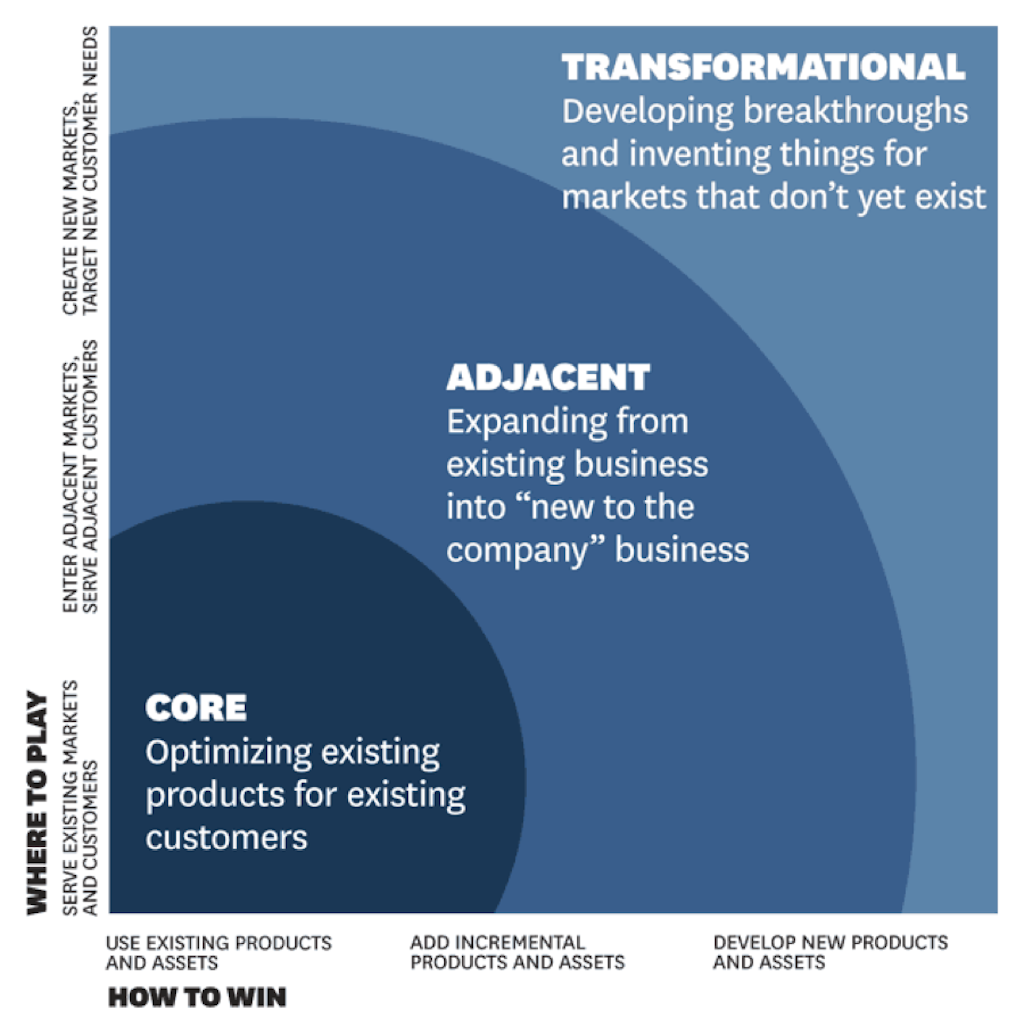
Innovation Matrix and Product/Market fit
Maximum ESA R&D Co-Funding Relative to Company Revenue
ESA R&D co-fundingshould only make a marginal revenue contribution in the long term. Therefore, funding should not exceed an average of 20% of the entity's total revenue over five years. Requests for project funding that exceed this limit are generally not approved by the delegation.
To assess the ESA R&D co-funding revenue share, the requestor must provide the company revenues of the past three years, a revenue forecast for the current year, and a revenue forecast for the coming year (i.e., Y-3 to Y+1). For the same years, the requestor must also provide received and predicted ESA R&D co-funding amounts.