
International research organisations: SESAME, ELI, SEEIIST, DUNE and GBC
Switzerland is also involved in other international research organisations and projects, both as an observer and an active participant contributing its know-how and technical expertise. SERI is responsible for managing these activities, from establishing budgets and evaluating the benefits of participation to signing international agreements on Switzerland’s behalf. Representatives from the relevant Swiss scientific communities are closely involved in this work.
Synchrotron-light for Experimental Science and Applications in the Middle East (SESAME)
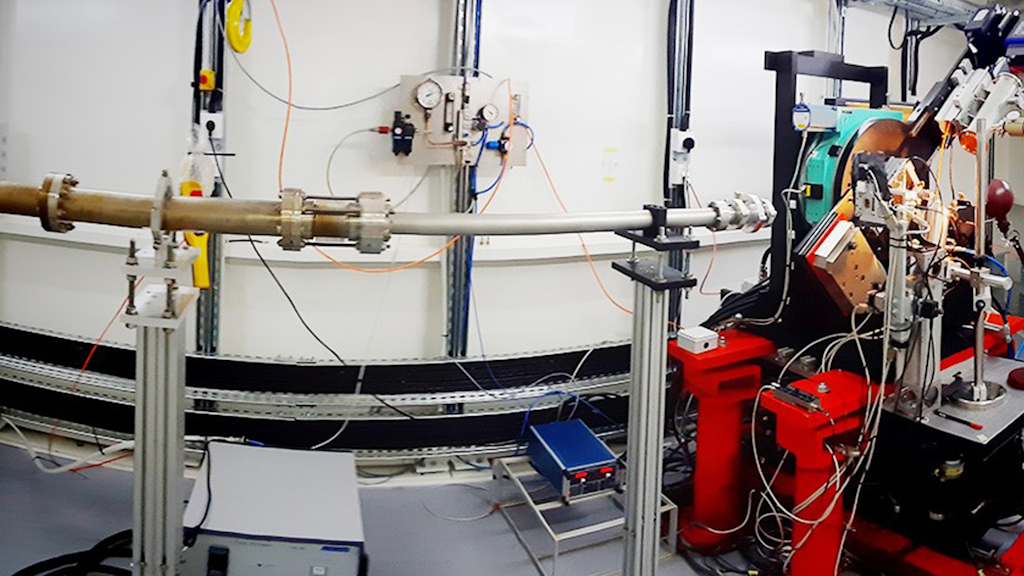
SESAME is an international research organisation that operates a third-generation synchrotron light source in Jordan. Since 2018, researchers from all over the world have been able to apply for beam time and conduct their experiments on one of the five available beamlines.
The member states of SESAME are Cyprus, Egypt, Iran, Israel, Jordan, Pakistan, Palestine and Turkey. In 2010, Switzerland joined many other countries and organisations holding observer status, including Brazil, Canada, China, CERN, the EU, France, Germany, Greece, Italy, Japan, Kuwait, Portugal, Russia, Spain, Sweden, the United Arab Emirates, the UK and the USA.
Developed under the auspices of UNESCO and modelled on CERN, SESAME has two main objectives:
- strengthening scientific capacities in the Middle East.
- promoting peace in the region through international cooperation.
The project therefore also has a significant diplomatic dimension, similar to that of CERN when it was founded in 1954.
SERI represents Switzerland on the SESAME Council. As an observer, Switzerland does not pay any membership contributions, but it does provide funding for SESAME on an ad-hoc basis. For example, in 2020 and 2024, the Paul Scherrer Institute (PSI) received funding to upgrade parts of the SESAME accelerator and cooling systems. The PSI is also involved in the SUNSTONE project, which aims to reinforce SESAME in the long term and consolidate its position as an international research centre.
Extreme Light Infrastructure ERIC (ELI ERIC)
ELI ERIC is an ultra-high intensity laser infrastructure comprised of three pillars: one in the Czech Republic (ELI Beamlines), one in Hungary (ELI-ALPS) and one in Romania (ELI-NP). ELI ERIC was established in 2021 and in 2022, its infrastructure was made available to scientists from all over the world. The powerful lasers found here enable groundbreaking research to be conducted in materials science, physics and biology. Construction of the three ELI sites was mainly paid for through the European Regional Development Fund (ERDF). Funding for operation of the infrastructure comes from ELI ERIC members and observers.
Switzerland is neither a member nor an observer of ELI ERIC. Nevertheless, the Photon Science Roadmap for Research Infrastructures (PDF), published by the Swiss Photo Community in 2021, describes ELI ERIC as offering particularly promising research possibilities that are not available anywhere else. It therefore recommends close monitoring of development of this infrastructure. Funding from the second Swiss contribution is earmarked for bilateral projects relating to ELI ERIC.
South East European International Institute for Sustainable Technologies (SEEIIST)
Once the SEEIIST Institute has been built (exact location not yet decided), South East Europe will have a dedicated biomedical research facility specialised in the treatment of tumours using Hadron Therapy (HT). The first patients will be treated at the proton therapy centre from 2029. Currently, there is no centre for this type of therapy in South East Europe.
Like SESAME and CERN, SEEIIST has a distinct diplomatic dimension (Science for Peace). CERN, UNESCO, the European Commission and other related infrastructures and institutions are supporting SEEIIST during the preparatory phase. The SEEIIST Association is currently based at CERN and the Federal Department of Foreign Affairs (FDFA) has been working with SEEIIST to draw up a science diplomacy roadmap. SERI is monitoring the technical and scientific aspects of the project.
Long-Baseline Neutrino Facility (LBNF) et Deep Underground Neutrino Experiment (DUNE)
The LBNF/DUNE project seeks to unravel the mysteries of neutrino particles to gain a better understanding of the universe, specifically why they are predominantly comprised of matter instead of antimatter.
The LBNF facility, which will generate the world's most powerful neutrino beam, is under construction at Fermilab near Chicago, Illinois. It will host the DUNE experiment, which will be installed at the Sanford Underground Research Facility in South Dakota (United States). This project, which is funded and pursued as an international collaborative endeavour, is recognised as an essential complement to the research conducted at CERN to advance our understanding of particle physics.
Swiss researchers working in the field of neutrino physics, particularly at the University of Bern and the University of Basel, have made a significant contribution to this infrastructure. For its part, CERN is handling preparations for the European contribution to LBNF/DUNE. Specifically, the organisation is designing and testing the technology that will be used in the DUNE detectors and will deliver the cryogenic infrastructure for two of these detectors. In May 2019, the Federal Council decided to provide funding for CERN's in-kind contribution to LBNF/DUNE.
Global Biodata Coalition (GBC)
The Global Biodata Coalition (GBC) is a group of organisations that fund biodata resources, i.e. bioinformatics databases and analytical tools. The need for such resources has grown significantly over the past 20 years, becoming particularly acute during the coronavirus (SARS-CoV-2) pandemic. The immediate availability of genetic sequences and other relevant analytical results proved crucial in enabling researchers to respond quickly to this new virus. Biodata resources have now become indispensable for research in all areas of life sciences.
The GBC aims to map the complex landscape of biodata resources and ensure their long-term accessibility for research purposes.
Switzerland has its own institution, the SIB Swiss Institute of Bioinformatics, which manages several biodata resources of great interest. SERI has been a member and financial supporter of the GBC since 2020.
Index
State Secretariat for Education, Research and Innovation SERI
Xavier Reymond