
ITER / Fusion for Energy
The ITER thermonuclear experimental reactor aims to demonstrate the value of nuclear fusion for large-scale energy production. It will enable development of the knowledge and technologies required for building nuclear fusion power plants capable of producing safe, sustainable and clean electricity. With the signing of the agreement on Switzerland’s participation in EU programmes, Switzerland participates in ITER from 2026 as a member of the European Joint Undertaking Fusion for Energy.
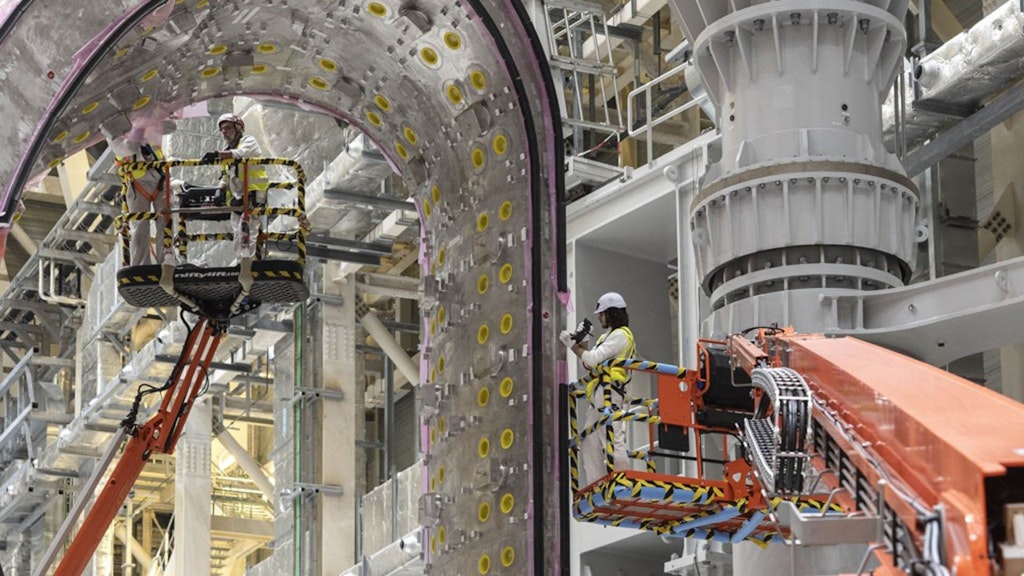
To meet the scientific and technological challenge of developing nuclear fusion, the European Union, China, India, Japan, Russia, South Korea and the United States created the international ITER Organization (IO) in 2007. At the Cadarache site in France, the IO is leading the construction of one of the most complex machines ever designed. On this extraordinary 42-hectare site, almost 5,000 people currently play a role in the ongoing machine and plant assembly and installation, which is carried out using components delivered by ITER members.
The EU has set up the Fusion for Energy Joint Undertaking (F4E), based in Barcelona, to coordinate its contribution. Scientific experiments at ITER are set to begin in 2034. Major nuclear experiments are expected as early as 2039.
Swiss participation
Having worked closely with the European Atomic Energy Community (Euratom) in the field of nuclear fusion since 1979, Switzerland chose to participate in ITER not as a direct member of the ITER Organization, but indirectly as a member of the European Joint Undertaking Fusion for Energy (F4E) at its founding in 2007. Switzerland contributed a total of CHF 274.5 million to the construction of ITER from 2007 to 2020. Numerous Swiss companies and institutions benefited from opportunities to supply equipment and services in a wide range of fields, including cryogenics, mechanics, power supplies, heating technologies and diagnostic systems.
Swiss participation in ITER was discontinued in 2021 until the end of 2025 due to Switzerland’s non-association to the Euratom research and training programme. With the signing of the European Union Programmes Agreement (EUPA), Switzerland resumed its participation in ITER on 1 January 2026, and will continue until the end of the European Joint Undertaking F4E.
Switzerland’s participation in international nuclear fusion research
SERI is responsible within the Federal Administration for all matters relating to nuclear fusion research, including Switzerland’s participation in ITER and Fusion for Energy. SERI also represents Switzerland on the Fusion Power Coordinating Committee, set up by the International Energy Agency (IEA) to monitor progress in fusion research globally. Close collaboration is maintained with the Swiss Plasma Center (SPC) at EPFL, which represents Switzerland in the European Consortium for the Development of Fusion Energy (EUROfusion). The latter supports and funds Europe-wide fusion research activities on behalf of Euratom. Finally, the Swiss ILO Office supports Swiss companies’ participation in the work of the organisations involved in the ITER project.
Links
State Secretariat for Education, Research and Innovation SERI
Xavier Reymond