
European Spallation Source: Europe’s most powerful neutron source
The European Spallation Source (ESS) in Lund (Sweden) will be the world's most powerful neutron source. It will generate intense neutron radiation, opening up new possibilities in materials research. As a founding member, Switzerland is involved in its construction, operation and technical development.
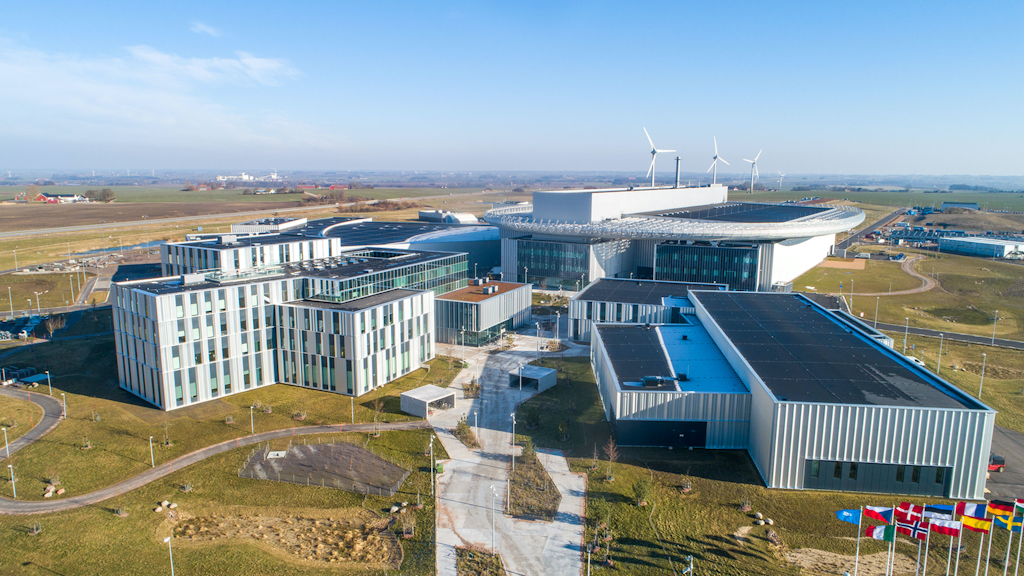
The ESS will enable researchers to examine archaeological artefacts and metal parts, study biomolecular processes and gain insights into the electronic structure and dynamics of novel superconductors. Unlike conventional neutron sources (such as the one at Institut Laue-Langevin ILL in Grenoble) the neutrons at ESS will not be produced by nuclear fission in a reactor, but rather by spallation: the process of bombarding metal (tungsten) with protons to release neutrons.
With its higher performance, the ESS will complement existing neutron sources – for example in the USA (HFIR, SNS), Japan (J-PARC), Germany (FRM II), France (ILL) and Switzerland (SINQ) – and open up new research prospects.
The costs of construction and operation of ESS until 2027 are expected to amount to some EUR 3.13 billion, of which EUR 1.84 billion will be spent on construction work (at 2013 prices). The first phase of operations began in 2019, while the infrastructure was being finalised.
Swiss participation
The ESS is established under the legal form of a European Research Infrastructure Consortium (ERIC). Switzerland joined as a founding member of the ESS-ERIC on 13 July 2015 and has been involved in the planning and construction of the ESS from the outset. Switzerland will also take an active part in its operation.
In March 2015, parliament approved Swiss participation in the ESS, allocating a total of CHF 130 million up to 2026. This corresponds to around 3.5% of construction costs and covers the first years of partial operation until 2026. This allocation was increased by CHF 35.6 million on 16 September 2020. Swiss researchers and institutions, such as the PSI and EPFL, played a very active role in the ESS planning phase and will continue to do so in the future. Part of Switzerland's contribution consists of components developed at Swiss research institutes.
SERI is responsible for Switzerland's participation in the ESS. It prepares Switzerland's official position and represents Swiss interests on the European Spallation Source ERIC Council as well as on the Administrative and Finance Committee (AFC). Participation in the ESS complements Switzerland's expenditure in existing neutron facilities located in Switzerland (SINQ) and abroad (ILL). This is done to ensure that Swiss researchers have the best possible access to these advanced research infrastructures.
Switzerland's participation in the ESS enables Swiss industrial companies to submit bids for ESS calls for tenders. Interested companies and institutions can obtain more information by contacting the Swiss ILO Office.
State Secretariat for Education, Research and Innovation SERI
Xavier Reymond