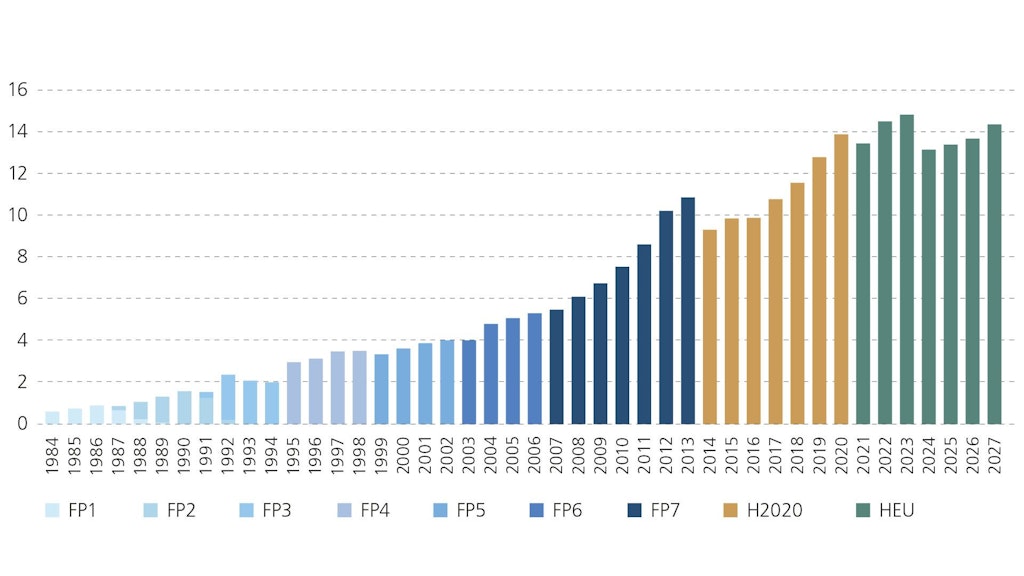
European research funding has a long tradition dating back to the 1950s. Framework programmes in the field of research and innovation were introduced in 1984. They have been constantly evolving ever since. Switzerland has been participating in the framework programmes in various forms since 1987.
Origin and development of the EU Framework Programmes
As early as the 1950s, the European Coal and Steel Community (ECSC) and the European Atomic Energy Community (Euratom) supported research into coal and nuclear power. The first research programme of the European Economic Community (EEC) that went beyond these topics was launched in the 1970s. In the early 1980s, the European Communities recognised the need for a comprehensive research strategy and launched the first framework programme in 1984.
The focus and structure of the framework programmes changed with the establishment of the EU in 1993. Initially, they primarily funded basic research; later they evolved into the “EU Framework Programmes for Research and Innovation”, which cover the entire innovation process and support scientific careers.
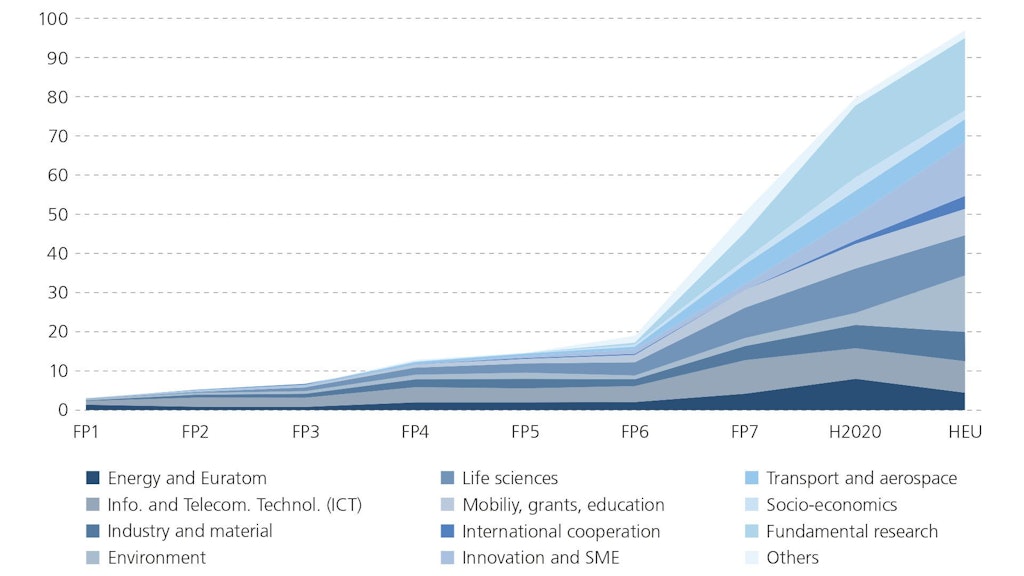
As the framework programmes have expanded, their budget has also steadily increased, and new thematic priorities such as innovation and climate protection have come to the fore. The Euratom Programme was part of the framework programmes until the third framework programme, but has been managed separately since then.
→ In addition to the framework programmes, the EU supports research and innovation through other programmes and initiatives. An overview of the programmes relevant to Switzerland can be found here.
Swiss participation at a glance
Since the 1950s, Switzerland has made an important contribution to European research and innovation, both in the context of cooperation with the EU and as a member of numerous international research organisations. Researchers and innovators in Switzerland have been participating in the framework programmes since 1987.
→ A detailed overview of Swiss participation in the EU Framework Programmes can be found in our publication "Swiss Participation in the European Union's Research and Innovation Programmes and Initiatives: Facts and figures 2023".
The individual framework programmes and Swiss participation
The 1st Framework Programme ran for four years and had a budget of EUR 3.3 billion (including contributions to the Euratom programme). Both the first and second framework programmes aimed to strengthen industrial competitiveness. Around half of the budget was allocated to the area of energy, followed by information and communication technologies (ICT). Although most of the programmes were organised according to the top-down principle, there were also bottom-up activities such as support for researcher secondments.
→ Switzerland has had access to the framework programmes as a non-associated third country since 1987. The first projects with Swiss participation started in 1988 and were funded by the project participants themselves.
The Single European Act (SEA) was signed in 1986 and was the first to include a chapter on research in an EU treaty. This provided a clear legal framework for the adoption of the framework programmes. The total budget for the 2nd Framework Programme was EUR 5.4 billion (including contributions to the Euratom programme). Information and communication technologies (ICT) now accounted for the largest share of the budget at the expense of energy. The programme also placed special emphasis on access to research infrastructures. It encouraged the mobility of researchers and supported actors in the innovation process. Small and medium-sized enterprises (SMEs) were also included.
→ Switzerland took part in the 2nd Framework Programme as a non-associated third country and was funded by the project participants themselves.
The concept of multidisciplinarity was introduced in the third framework programme. The aim of the programme was to meet technological challenges. The research area of information and communications technologies (ICT) remained the largest. The budget for the 3rd Framework Programme rose to EUR 6.6 billion (including contributions to the Euratom programme).
→ Switzerland participated in the 3rd Framework Programme as a non-associated third country. From 1992, the federal government made funding available for participation.
The 4th Framework Programme represented a major step forward compared to its predecessor. The Maastricht Treaty, signed in 1992, made the framework programmes the central funding instruments for EU research. The focus shifted from pure research and innovation to addressing social challenges. The budget doubled compared to the previous year to EUR 13.1 billion (including contributions to the Euratom programme).
→ Switzerland participated in the 4th Framework Programme as a non-associated third country. The federal government provided funding for participation.
The EU's 5th Framework Programme built on its predecessor, with a budget of EUR 14.9 billion (including contributions to the Euratom programme). It focused on four thematic programmes addressing clearly defined challenges. A major difference to the previous programmes was the increase in project size, with some collaborative projects involving more than 80 partners.
→ Switzerland participated in the 5th Framework Programme as a non-associated third country. The federal government provided funding for participation.
In 1997, the EU's research policy was reorganised with the signing of the Treaty of Amsterdam. The concept of the European Research Area (ERA) was developed and incorporated into the Lisbon Strategy in 2000. The aim was to make the EU the most competitive area of knowledge in the world. The subsequent framework programmes have been used to implement this EU research policy. The 6th Framework Programme had a budget of EUR 19.1 billion (including contributions to the Euratom programme).
→ From 1 January 2004, Switzerland participated for the first time in the framework programmes for research and innovation with the status of an associated third country. The association was linked to a mandatory federal contribution to the EU.
The 7th Framework Programme introduced important changes and extended the scope of the programme to exploratory research and innovation activities. For the first time, the programme ran for seven years instead of five. The budget amounted to EUR 55.6 billion (including contributions to the Euratom programme, excluding ITER), which, taking into account the new duration, was thus twice that of its predecessor. The 7th Framework Programme was greatly simplified to increase efficiency and facilitate access for researchers. Bottom-up basic research was encouraged with the establishment of the European Research Council (ERC). Fusion research was strengthened under the Euratom PFA to support the construction and operation of ITER.
→ Switzerland took part in the 7th Framework Programme as an associated third country. The association was linked to a mandatory federal contribution to the EU.
The Treaty of Lisbon, which came into force at the end of 2009, provided the legal basis for Horizon 2020, the 8th Framework Programme. It broadened the objectives of EU research policy. The focus shifted from industrial competitiveness to the implementation of the ERA concept. The budget was increased by almost 50 per cent compared to the seventh programme and amounted to EUR 82 billion (including the Euratom programme and ITER). Innovation was given significantly more weight in Horizon 2020, through the integration of the European Institute of Innovation and Technology (EIT) and the introduction of two large-scale pilot projects, so-called flagships for future and emerging technologies (FET Flagships).
→ From 2014 to 2016, Switzerland took part in the 8th Framework Programme as a partially associated third country. For the remainder of the programme, Switzerland was granted the status of a fully associated third country. During the partial association, the federal government provided funding for the areas without EU funding. For the associated areas, Switzerland paid an annual mandatory contribution to the EU.
The current 9th Framework Programme, Horizon Europe, runs from 2021 to 2027. and is combined with the Euratom Programme, ITER and DEP to form the Horizon Package from a Swiss perspective.
→ Up-to-date information on Switzerland's status in the Horizon package can be found here.