
Horizon package 2021–2027
The Horizon package comprises the Horizon Europe, Euratom and Digital Europe (DEP) research programmes and the ITER research infrastructure. Researchers and innovators in Switzerland participate as beneficiaries in calls for proposals of Horizon Europe, the Euratom programme and the DEP, from the 2025 programme year onwards.
Status of Switzerland
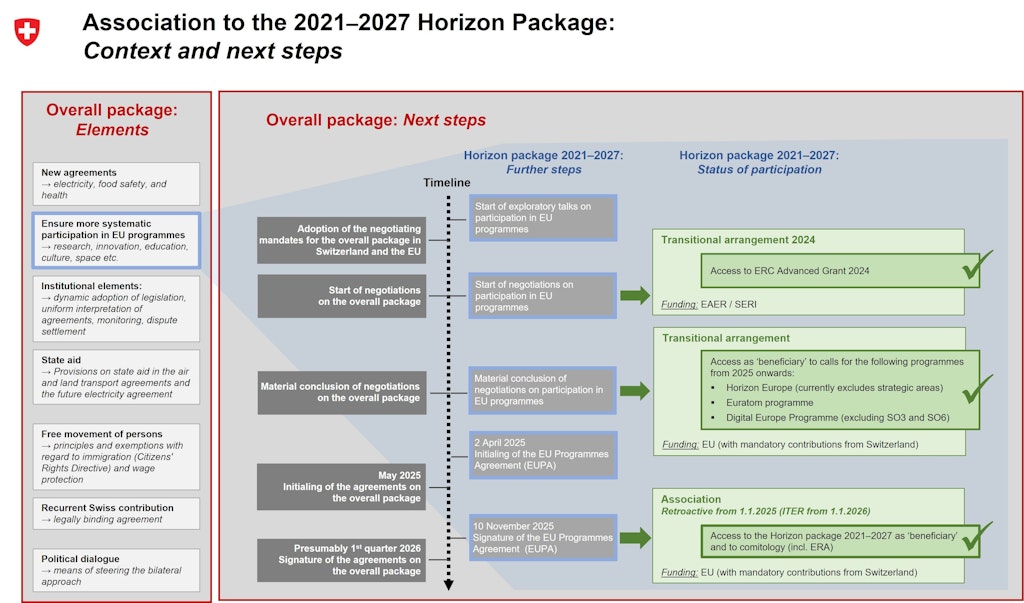
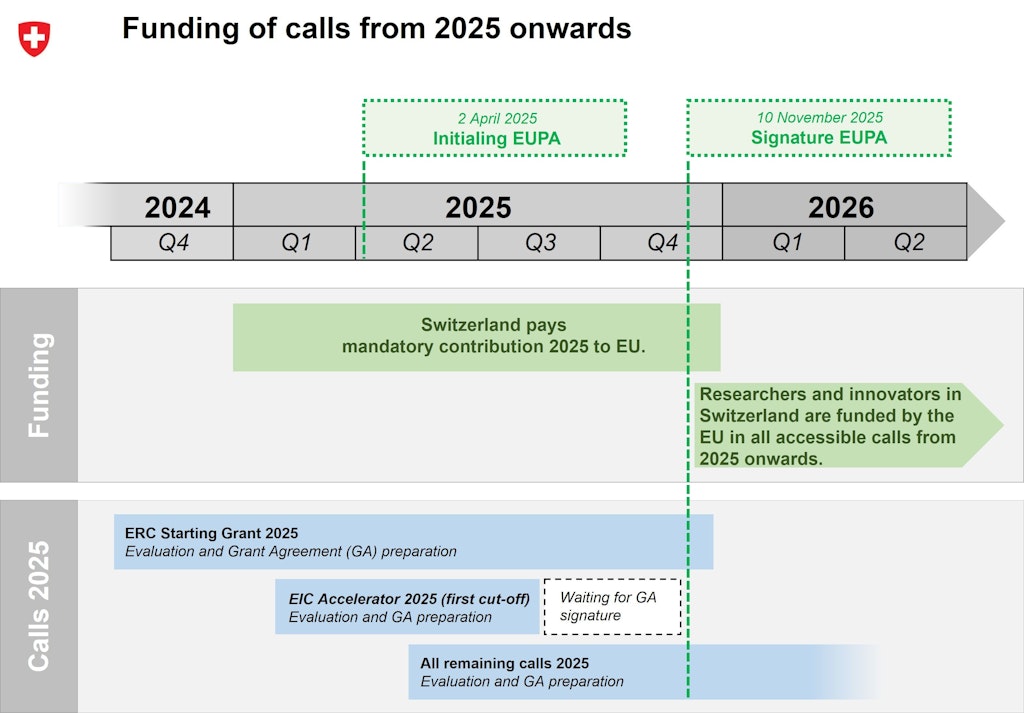
The EUPA was signed on 10 November 2025. It applies with immediate effect, meaning that Switzerland is associated to Horizon Europe, the Euratom programme and the DEP retroactively from 1 January 2025. Project funding is provided from the European Commission, as Switzerland pays a mandatory contribution to the EU for this purpose. The EUPA was signed ahead of the package Switzerland-EU but remains part of this package.
The diagram below shows the steps leading up to the final conclusion of the EU Programme Agreement (EUPA):
EU Programmes Agreement (EUPA)
The EU Programmes Agreement (EUPA) forms the legal basis for Switzerland's participation in EU programmes. It currently covers participation in Horizon Europe, the Euratom programme, the ITER research infrastructure and the Digital Europe Programme (referred to collectively as the Horizon package 2021–2027), as well as Erasmus+ and EU4Health. The EUPA also paves the way for potential future participation in other EU programmes. With each new programme generation, Switzerland is free to decide which of the programmes open to third countries it wishes to join.
- The valid EU Programmes Agreement can be found here.
- Factsheet: EU programmes
- FAQ (EU programmes from page 31 onwards, in German)
For questions regarding EU4Health, the Federal Office of Public Health is available at: international@bag.admin.ch.
Participation in calls from the 2025 programme year onwards
Researchers and innovators in Switzerland participate in calls of Horizon Europe and the Euratom programme as beneficiaries, from the 2025 programme year onwards. This means that they can submit project proposals in the role of coordinator. Information on Switzerland's participation in calls for proposals in areas considered strategic by the EU (including quantum and space) can be found under Strategic areas.
Researchers and innovators in Switzerland participate as beneficiaries in calls for proposals of the Digital Europe Programme, from the 2025 programme year onwards. This means that they can submit their project applications in the role of coordinator. Specific Objectives 3 (Cybersecurity) and 6 (Semiconductors) are exceptions to this; they are only accessible to EU member states and, to a limited extent, to countries in the European Economic Area (EEA). For questions about the Digital Europe Programme: digital-europe@sbfi.admin.ch.
Funding of calls 2025
Budget planning from the 2025 programme year onwards
- For all calls for proposals from the 2025 programme year onwards, participants in Switzerland submit their project proposals as beneficiaries and thus apply for EU funding.
- The budget of the Swiss partner must be included in the total grant amount that the consortium is requesting from the EU.
Strategic areas
Research and innovation actors in associated third countries such as Switzerland must undergo a validation process in order to gain access to Horizon Europe and DEP calls for proposals in areas considered strategic by the EU (e.g. quantum and space). The EU's basis for this restricted access are Article 22(5) and Article 12(6) of the respective programme regulations.
Following the completion of the European Commission’s validation process, Switzerland has gained full access to calls in strategic areas in the Horizon Europe Work Programme 2026–2027 (e.g., Cluster 4: Artificial Intelligence, quantum, communication and network technologies, as well as space-related research topics). Certain calls in the field of space were not subject to this validation process and remain inaccessible. In DEP, Switzerland was already granted access to calls for proposals in strategic areas of the 2025–2027 work programme in March 2025.
Participation in calls 2021–2024
In order to efficiently compensate for Switzerland's third-country status in the Horizon package 2021–2027, the Federal Council has decided on transitional measures for the 2021–2024 calls for proposals (calls that have 2021, 2022, 2023 or 2024 in their call identifier):
- Transitional measures for accessible parts of the programme: SERI provides direct funding to researchers and innovators in Switzerland for their participation in collaborative projects. Project participants receive funding as if Switzerland were an associated country, but from SERI rather than the EU. SERI will fund these projects for their entire duration, regardless of Switzerland's status and subject to parliamentary budget decisions.
- Transitional measures for non-accessible parts of the programme: For non-accessible calls for proposals, SERI provides funding through temporary instruments that are implemented either by SERI itself, the Swiss National Science Foundation (SNSF), Innosuisse or the European Space Agency (ESA). These measures are based on the respective EU calls for proposals as far as possible. For example, SNSF Starting Grants are an SNSF instrument that covers the corresponding calls of the European Research Council (ERC-Grants).
Overview of the Horizon package
Horizon Europe, the Euratom programme, the Digital Europe Programme and the ITER research infrastructure are dealt with as part of a uniform legislative and budgetary process in Switzerland; in this context they are therefore known collectively as the Horizon package.
Horizon Europe
With a budget of EUR 95.5 billion, Horizon Europe is the EU's largest and most ambitious research and innovation programme to date. It aims to strengthen the EU's competitiveness and promote growth through excellence in research. It is also intended to create jobs and support industrial cooperation in the European Research Area. The central pillars of the programme are:
- Excellent Science, which is advanced by the European Research Council and the Marie Skłodowska-Curie Actions.
- Global Challenges and European Industrial Competitiveness, which supports projects in areas such as health, climate, energy and mobility.
- Innovative Europe, which strengthens innovation potential through the European Innovation Council and the European Institute of Innovation and Technology.
In addition, there is a focus on widening participation and strengthening the European Research Area, which promotes cooperation and excellence in research. The Open Science Policy, which obliges project participants to make their research publicly accessible, is another important aspect of the programme.
Euratom Research and Training Programme
The Euratom programme complements Horizon Europe and funds nuclear research and innovation; it has a budget of EUR 1.38 billion for the 2021–2025 period. The scope of the programme covers nuclear fusion and fission, including safety issues, waste management and radiation protection. Fusion research supports the ITER reactor and the development of future fusion power plants to utilise nuclear fusion as a clean energy source. The programme also promotes expertise, training and technology transfer.
International Thermonuclear Experimental Reactor (ITER)
The ITER infrastructure project is an international collaboration launched in 2006 to build the ITER thermonuclear experimental reactor in Cadarache, France. The aim of this infrastructure is to demonstrate the value of nuclear fusion for industrial-scale energy production, and to develop the knowledge and technologies required for the subsequent construction of nuclear fusion power plants to produce electricity that is safe, sustainable and clean because it does not produce high-level and long-lasting radioactive waste. Fusion for Energy (F4E) works at European level to coordinate the provision of the European contribution to the construction of ITER. Since 1 January 2026, Switzerland has been participating once again in the construction of ITER as a member of F4E, under the same conditions that were applied until 2020 (further information).
Digital Europe Programme (DEP)
The DEP aims to improve digital capacities in Europe and complements other EU programmes for research and innovation such as Horizon Europe. With a budget of over EUR 8.1 billion, it provides funding for work in areas such as supercomputing, artificial intelligence, cybersecurity, semiconductors, advanced digital skills and the broad use of digital technologies in the economy and society. There is also a network of European Digital Innovation Hubs that support industry, SMEs and public administration in their digital transformation.
Further information
- Botschaft zur Finanzierung der Schweizer Beteiligung an den Massnahmen der Europäischen Union im Bereich Forschung und Innovation in den Jahren 2021–2027 (Horizon-Paket 2021–2027)
- Verordnung vom 20. Januar 2021 über die Massnahmen für die Beteiligung der Schweiz an den Programmen der Europäischen Union im Bereich Forschung und Innovation (FIPBV)
- Bundesbeschluss über die Finanzierung der Schweizer Beteiligung an den Massnahmen der Europäischen Union im Bereich Forschung und Innovation in den Jahren 2021–2027 (Bundesbeschluss zum Horizon-Paket 2021–2027)
Index
Transitional measures 2021–2024 for the Horizon package
To minimise the consequences of Switzerland's third country status in the Horizon package, the Federal Council decided on transitional measures for the years 2021–2024. For this purpose, CHF 2.6 billion was made available, which SERI either pays out directly to project participants or distributes via the Swiss National Science Foundation (SNSF), Innosuisse and the European Space Agency (ESA).
Funding for collaborative projects 2021–2024 under the Horizon package
If you are involved in a collaborative project 2021–2024 under the Horizon package that has been approved by the European Commission, you can submit your application for SERI funding here.
Funding for mono-beneficiary projects 2021–2024 under the Horizon package
If the European Commission (EC) has positively evaluated your mono-beneficiary project from the programme years 2021 to 2024, you can submit your application for SERI funding here.
European Partnerships in Horizon Europe
European Partnerships are EU initiatives supported by Horizon Europe. They bring together public and private actors to fund research and innovation programmes that contribute to EU priorities such as the Green Deal, the digital strategy and pandemic preparedness.
Digital Europe Programme
As part of the Horizon package 2021–2027, the Digital Europe Programme (DEP) strengthens Europe's digital capacities and complements programmes such as Horizon Europe. With over EUR 8.1 billion in funding, the DEP covers high-performance computing, artificial intelligence, cybersecurity, semiconductors, digital skills and the use of digital technologies.